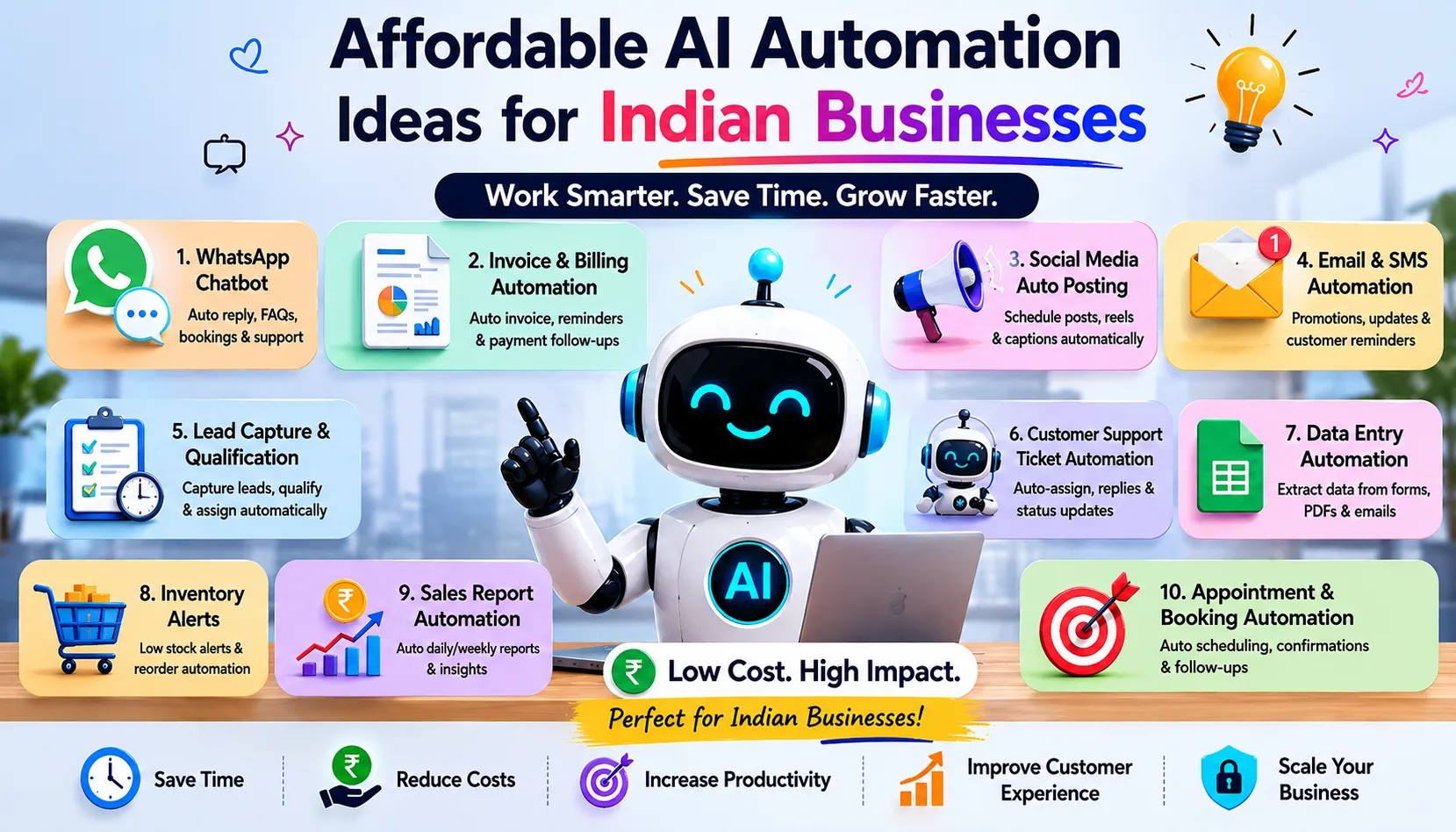
Affordable AI Automation Ideas for Indian Businesses
Let's skip the usual opener about "the digital revolution" and get straight to it.
If you run a small or mid-sized business in India and you haven't seriously looked at AI automation yet, you're already behind — not in a catastrophic way, but in the way where your competitor across town is responding to leads at midnight while you're paying someone to do it at 10 AM the next morning.
That's the real gap. Not technology. Response time, consistency, and capacity.
The good news is that affordable AI automation for Indian businesses is no longer a contradiction in terms. It used to be. Three years ago, meaningful automation meant enterprise contracts, dedicated IT people, and implementation timelines that stretched for months. That's genuinely not true anymore.
First, Let's Address the Elephant in the Room
A lot of business owners still believe one of two things: either AI automation is too expensive for a small operation, or it's going to replace their staff and create problems they don't want to deal with.
Both concerns are understandable. Neither holds up well against actual numbers.
Indian businesses have started adopting AI and deep tech to automate their operations in meaningful ways — and it has reduced operational costs while improving efficiency across the board. Some of the more forward-thinking SMEs have been running AI workflows for over two years now at a cost that's frankly lower than a single mid-level hire.
On the job replacement fear — the businesses using automation well aren't cutting teams. They're stopping themselves from hiring five extra people to handle work that three people plus good software can manage. That's a different thing entirely.
The Token Cost Problem (And How Some Companies Are Solving It)
Here's something most AI automation articles won't tell you: a hidden cost that catches businesses off guard is AI token pricing. Most automation platforms route your workflows through third-party LLMs — OpenAI, Anthropic, Google — and bill you based on usage. At scale, that adds up fast.
There are platforms that charge way too much for AI automation precisely because of these rising token costs. But a few players — Rymiq AI is one example — have started offering in-house LLM setups for businesses. The idea is simple: you run a language model on your own infrastructure instead of paying per token to a cloud provider. For businesses with high-volume workflows, this can cut running costs dramatically.
It's worth asking any AI automation vendor you talk to: are we running on your infrastructure, or are we paying third-party token costs on top of your fee? The answer will tell you a lot about what your bill looks like six months from now.
Where Does Automation Actually Make Sense for an Indian SME?
Not everywhere at once. That's the honest answer.
Start where your biggest pain is. Here are the areas where Indian businesses are seeing the most concrete, measurable impact — not theoretical impact, actual rupee savings and hours recovered.
WhatsApp First, Everything Else Second
India has 487 million WhatsApp users. Your customers are on it. Your suppliers are on it. Leads come through it. Complaints come through it. Order confirmations go through it.
And yet most small businesses are still managing all of this manually, with one or two people juggling dozens of conversations across multiple phones.
AI-powered WhatsApp automation tools like Wati and AiSensy handle 70-80% of routine queries — pricing, availability, order status, payment links — automatically, around the clock. A typical setup costs ₹2,000-3,000 per month. The businesses using this replace the equivalent of two or three customer service staff who'd otherwise cost ₹15,000-25,000 per month in combined salaries.
Setup takes a few hours. The difference in response time is immediate. If there's one thing on this list worth prioritizing, it's this one.
GST and Accounting — Nobody's Favourite Task, Easily Automated
Ask any business owner with 20+ employees what they dread most. Odds are GST compliance is in the top three.
Tally Prime integrated with AI tools, platforms like ClearTax, Zoho Books, and newer entrants like hisabkitab can bring monthly GST compliance time from 8-12 hours down to under 2. Indian SMBs spend ₹15,000-30,000 a year on CA fees for basic GST work — not because CAs are expensive, but because the task volume demands it. AI-powered accounting handles the routine calculations, flags errors before filing, generates reports automatically, and keeps everything audit-ready.
For very small operations, Vyapar is worth a look. It runs on Android, which matters because a lot of Indian business owners manage their finances entirely from their phones. It's not the most sophisticated tool on the market, but for businesses under ₹40 lakh annual revenue, it's often more than enough.
Lead Management and Follow-Ups — Where Most Businesses Leak Money
Here's a pattern that repeats across almost every Indian SME in sales-driven sectors: a lead comes in, gets a first response, and then falls through the cracks because everyone is busy.
No one followed up on day three. No one sent the proposal reminder. The lead went cold, and six weeks later they bought from someone else.
CRM automation solves this. Zoho CRM with its AI assistant Zia, Freshsales with Freddy AI — these platforms score leads based on engagement, predict which prospects are likely to convert, and trigger follow-up sequences automatically. They don't forget. They don't have bad days. They don't decide a lead isn't worth chasing because it's Friday afternoon.
Zoho is particularly relevant for Indian businesses because it supports Indian payment gateways, GST, and regional languages. HubSpot's free tier is another solid option — genuinely capable, not a watered-down trial version, and works well for startups that can't yet fund a full sales team.
Workflow Automation — The Connective Tissue Most Businesses Are Missing
Most small businesses run on five or six different apps — a CRM, a WhatsApp tool, a spreadsheet, an email platform, maybe a project management tool. None of them talk to each other. Someone copies data from one into another all day long.
Zapier fixes this. It connects over 6,000 apps and automates the flow of information between them. A customer fills a form, Zapier adds them to the CRM, sends a WhatsApp message, and pings the sales team on Slack — simultaneously, without any human involvement. Paid plans start around ₹1,500 per month. For what it does, that's a fairly absurd bargain.
Make (formerly Integromat) does something similar with a more visual interface — better suited for teams that need to build more complex conditional workflows. Neither requires a developer to operate.
Content and Marketing — Finally, Something Small Teams Can Actually Handle
Marketing is where Indian SMEs feel the squeeze most painfully. A full-time content writer, a social media manager, a designer — that's easily ₹60,000-80,000 per month in salaries, if you can even find and retain good people.
AI doesn't fully replace that. Let's be honest about that. But it dramatically changes what a small team can produce.
There's a real example worth sharing: a furniture manufacturer in Kerala with 12 employees replaced an ₹18,000/month social media freelancer with ChatGPT for captions, Canva AI for graphics, and Buffer for scheduling. Total monthly spend dropped to ₹500. The output quality actually went up because the owner, who knows his products better than any freelancer could, was now generating the first draft himself with AI helping fill the gaps.
Tools like Jasper and Copy.ai handle ad copy, landing pages, and product descriptions. Pictory turns blog posts into short videos with voiceovers and captions — no editing skills needed. For businesses targeting Hindi or regional language audiences, several tools now support multiple Indian languages, which is a market gap that was barely addressed two years ago.
Customer Support Chatbots — Not as Complicated as They Sound
Outside of WhatsApp, AI chatbots on websites can handle first-level support, collect lead details, answer FAQs, and escalate complex issues to humans. India's chatbot market is growing at nearly 26% annually, which means the number of affordable, India-specific options keeps expanding.
Haptik (Reliance Jio-backed) and Gupshup are the established names here — multilingual, scalable, and built for Indian use cases across e-commerce, healthcare, and financial services. For businesses getting a high volume of the same ten questions every day, deploying a chatbot on the website is a straightforward win.
HR and Payroll — Often the Last Thing Owners Think to Automate
As teams grow past 15-20 people, HR administration quietly becomes a real operational drain. Payroll calculations, attendance, leave tracking, PF compliance, offer letters — it's not complex work, but it takes time and it has zero tolerance for errors.
Indian-built tools like Keka and Darwinbox handle most of this. Payroll runs automatically. Compliance is tracked. Employees self-serve leaves and documents without running to HR. For a business scaling from 10 to 50 employees, this category tends to pay for itself well within the first quarter.
When Off-the-Shelf Tools Don't Fit
Sometimes the standard platforms don't quite match how a business actually operates. A manufacturing unit with a custom inventory logic, a services firm with a bespoke quoting process, a D2C brand with unusual fulfillment workflows — these businesses often find that generic SaaS tools solve 70% of the problem and create friction everywhere else.
This is when custom AI automation in India becomes relevant. Indian AI service providers are increasingly offering modular builds — start with one workflow, prove it, expand from there. The upfront cost is higher, but over 24 months the total cost is often lower than paying for several partially-useful SaaS subscriptions simultaneously.
One practical thing to check before signing with any vendor: do they understand Indian compliance requirements? Do they price in INR? Have they built for businesses in your sector before? The answers reveal a lot about whether they'll be useful partners or expensive consultants who deliver something that needs to be rebuilt.
The Practical Starting Point
Pick one workflow. Not five, not three. One.
Find the single area where you're losing the most time or money — customer response speed, GST compliance, lead follow-ups, whatever it is. Find a tool built specifically for that problem. Implement it fully, measure the result, and then decide what to automate next.
The businesses that automate everything at once tend to implement nothing well. The businesses that start narrow and expand gradually tend to build operational advantages that actually compound.
AI automation for SMEs is not a transformation project. It's a series of small, practical decisions that stack up over time. The first one is usually the hardest. After that, the logic tends to take care of itself.
To Put It Plainly
The Indian businesses pulling ahead right now aren't always the ones with bigger budgets. They're the ones that stopped treating automation as a future consideration and started treating it as a current expense with a measurable return.
Affordable automation software exists. Custom AI automation in India is viable. The tools built for Indian GST, Indian languages, and Indian customer behaviour are better than they've ever been.
The question isn't really whether your business can afford to automate. It's whether it can afford to keep doing things the slow way while others don't.