
Let me be blunt with you — if you're running a Shopify store in 2026 and you haven't seriously looked into AI yet, you're not just missing a trend. You're actively making things harder for yourself than they need to be.
I say that not to scare anyone, but because the gap between stores using AI and stores that aren't has become pretty visible. And the stores on the wrong side of that gap? They're working twice as hard for results that just aren't keeping up.
A Chatbot Used to Be Enough. It Really Isn't Anymore.
There was a point — maybe 2021, 2022 — where plugging a chatbot into your Shopify store made you feel like you were ahead of the curve. And honestly, back then, you kind of were. Customers could get quick answers, you weren't personally replying to "where's my order?" at midnight, and life felt manageable.
That version of AI? It's basically the appetiser now.
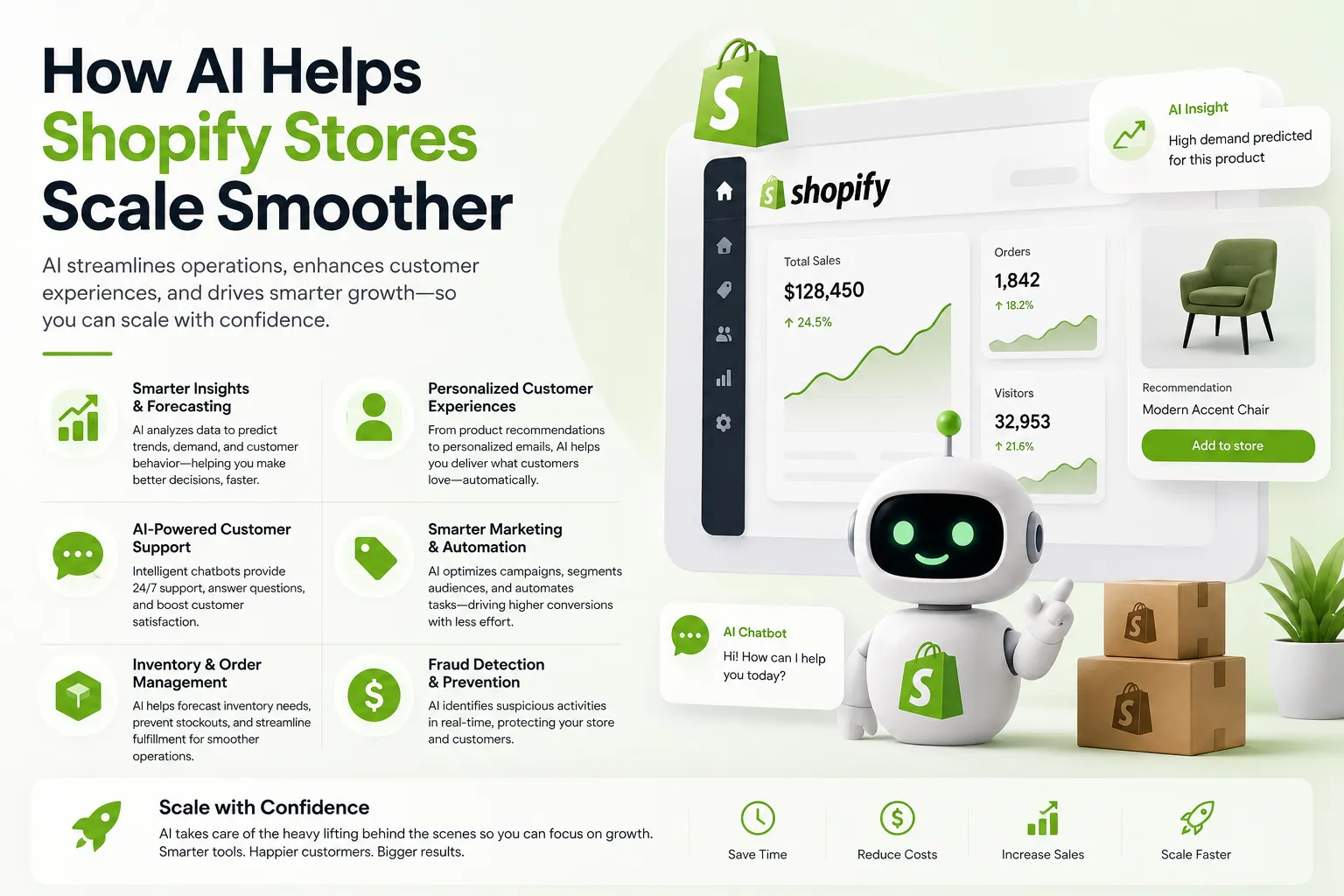
Today's AI on Shopify isn't just sitting there waiting for someone to type a question. These tools are actively working — processing refund requests, walking customers through checkout when they're stuck, recommending products based on what the customer actually looked at (not just what's on sale), and handling post-purchase support without you lifting a finger. Give it the right permissions and it essentially becomes a digital sales rep who shows up every single day, never calls in sick, and somehow remembers every customer's preferences.
For store owners who can't yet afford to build out a full support team, this is genuinely a game changer.
The Inventory Headache Is Largely Self-Inflicted Now
Here's something nobody really wants to admit: most inventory problems in eCommerce aren't bad luck. They're the result of decisions being made slowly, manually, and with incomplete data.
You reorder based on a gut feeling or last month's numbers. You run a flash sale without adjusting forecasts. You miss a supplier lead time because you were focused on something else that week. These aren't catastrophic failures — they're just the normal friction of managing things manually at scale. And the cost adds up quietly.
AI inventory tools essentially put a second brain on this problem. One that doesn't sleep, doesn't get distracted, and is pulling from your actual sales patterns, seasonal trends, and market signals simultaneously. When stock hits a low threshold, reorder workflows fire automatically. When demand is expected to spike — say, a gifting season or a viral product moment — the system adjusts buying quantities ahead of time rather than after you've run out.
Doe Beauty, a Shopify brand that scaled into a multimillion-dollar business, reportedly saves around $30,000 a week just from having automated these workflows through Shopify Flow. Per week. That number stuck with me.
Your Emails Are Probably Leaving Money on the Table
Most Shopify store owners I talk to send the same emails to their entire list. Big announcement, same discount code, same timing. And hey — it works, sort of. You'll get some opens, some clicks, a few conversions.
But here's what's happening in the background: a customer who bought from you three times in the last six months and a customer who signed up eighteen months ago and never purchased are getting the exact same message. That's a missed opportunity both ways.
AI Shopify marketing fixes this not by being fancier, but by being smarter about timing and relevance. It tracks behaviour — what someone browsed, how often they open your emails, whether they abandoned a cart, how long it's been since their last purchase — and builds communication flows around those signals automatically. A customer who's been quiet for 60 days gets a win-back sequence. Someone who just bought gets a thoughtful follow-up with complementary product suggestions, not another generic promo.
The difference in conversion rates between these personalised flows and standard batch-and-blast campaigns is not small. Stores that have made this switch tend to notice it pretty quickly.
Workflow Automation: This Is Where It All Connects
I think people sometimes imagine AI Shopify tools as a bunch of separate apps doing separate things. And sure, that's technically accurate. But the real value shows up when these pieces connect into proper workflow automation — where one event triggers a chain of actions that runs completely on its own.
Here's a simple example of what that looks like in real life:
A customer places an order. That instantly triggers an inventory update, which checks stock levels, which flags a reorder if you're running low, which routes the order to the right fulfilment location, while simultaneously sending the customer a personalised confirmation email that includes relevant product tips based on what they actually bought. No human had to touch any of that.
Now scale that across hundreds of orders a day, multiple product lines, different customer segments, various fulfilment partners. Doing all of that manually isn't just inefficient — it's genuinely not possible without a team that most small Shopify stores can't afford. With the right AI business automation in place, a two or three person operation can handle the volume that used to need ten.
Shopify Flow handles a lot of this natively, and the third-party ecosystem around it keeps expanding. Recent data from Q1 2026 showed that AI-assisted workflows were completing and shipping at significantly higher rates than old rule-based automations. The accuracy gap alone justifies the switch.
Personalisation: Customers Notice When It's Missing
There's a reason people keep going back to Amazon even when they could get the same product cheaper somewhere else. Part of it is convenience. But a big part is that Amazon's storefront actually feels like it knows you. The recommendations make sense. The emails are relevant. It doesn't feel like you're shopping a catalogue — it feels like the store is paying attention.
That expectation has now spread everywhere. Customers who've been trained by Amazon, Spotify, and Netflix to expect relevance are visiting your Shopify store and noticing when the experience feels generic.
AI product recommendation engines tackle this directly. Instead of a static "customers also bought" block that shows the same four items to everyone, AI-driven systems adapt in real time based on individual browsing behaviour, past purchases, and what similar customers actually ended up buying. The recommendations quietly improve the longer the system runs, because it's learning from every session.
For fashion brands, beauty stores, home décor — anywhere that styling, pairing, or personal taste plays a role in purchase decisions — this kind of personalisation noticeably lifts average order value. And it does it without discounting.
Be Honest About Where You're Losing Time
If you want a practical starting point, stop thinking about AI as a technology upgrade and start thinking about it as a time audit. Where are you or your team doing the same thing over and over? Where do mistakes happen because someone forgot to check something? Where are you reacting to problems that could have been flagged three days earlier?
Those are your automation opportunities. And most of them have an AI-powered Shopify solution that plugs in without requiring you to hire a developer or rebuild your stack.
Start with one workflow — maybe abandoned cart recovery, maybe inventory reordering — get it running cleanly, and then expand. The merchants who try to do everything at once tend to get overwhelmed and end up using nothing properly. The ones who start small and build methodically end up with systems that genuinely compound over time.
One Last Thing
The stores scaling smoothly in 2026 aren't necessarily the best-funded or the most creatively brilliant. A lot of them are just operationally smarter. They've put AI to work on the repetitive, data-heavy, time-sensitive parts of their business so their actual team can focus on the stuff that needs a human — the brand decisions, the creative direction, the customer relationships that matter.
That's not a futuristic vision. It's already happening. The only real question is whether you're building those systems now or planning to get around to it eventually.
Eventually has a way of costing more than it should.