In today's AI-driven market, leveraging technology is no longer a competitive edge — it is a baseline expectation. The businesses that will lead the next decade are not simply the ones working harder, but the ones working smarter by letting intelligent systems handle what humans shouldn't have to.
Let's be honest: the sheer volume of conversation around AI can feel exhausting. Every conference keynote, every LinkedIn post, every industry newsletter breathlessly declares that artificial intelligence is transforming everything. And yet, when you look past the noise and sit down with actual operations teams, finance managers, and logistics heads, you quickly realise that the hype — while occasionally overblown — is rooted in something very real. AI is quietly, steadily reshaping how work gets done. Not with dramatic robot takeovers, but with small, compounding automations that free up human capacity for what genuinely matters.
"The question is no longer whether to adopt AI automation — it's which processes to automate first and how fast you can move without losing control of quality and compliance."
Almost every industry today is using AI to handle the repetitive, time-consuming tasks that once consumed hours of skilled employees' time — invoice generation, sales pipeline management, logistics tracking, stock inventory updates, customer query routing, and much more. The businesses that embrace this shift intelligently, with a focus on human-assisted automation at optimised cost, are the ones building a durable advantage over their competitors.
Instead of debating whether to be "for" or "against" the AI era, the more productive question is: what can you actually use as a weapon in the market? This article breaks down the key business processes you can automate right now — and the tools powering them in 2026.
70%
of repetitive business tasks automatable with current AI
3.5×
faster decision-making with AI-powered workflow tools
40%
average reduction in operational cycle times reported in 2025–26
What Is AI Business Automation, Really?
It's worth drawing a clear line here. Traditional workflow automation works on fixed if-then rules — if a form is submitted, send an email. If an invoice is created, log it in the spreadsheet. Useful, but rigid. The moment something falls outside the predefined rule, a human has to step in.
AI workflow automation is fundamentally different. It embeds intelligence directly into the process — the system can read unstructured data, make contextual decisions, learn from exceptions, and act autonomously in real time. A 2026 AI automation platform doesn't just trigger a task; it understands what the task requires, adapts to edge cases, and scales with your business without adding headcount to manage the extra complexity.
The best platforms today combine robotic process automation (RPA), large language models (LLMs), AI agents, and process mining into a single orchestration layer. Finance, HR, procurement, IT, healthcare, and logistics teams are benefiting the most — because these functions run on high-volume, approval-heavy, compliance-sensitive processes that are perfect candidates for intelligent automation.
Key Business Processes to Automate in 2026
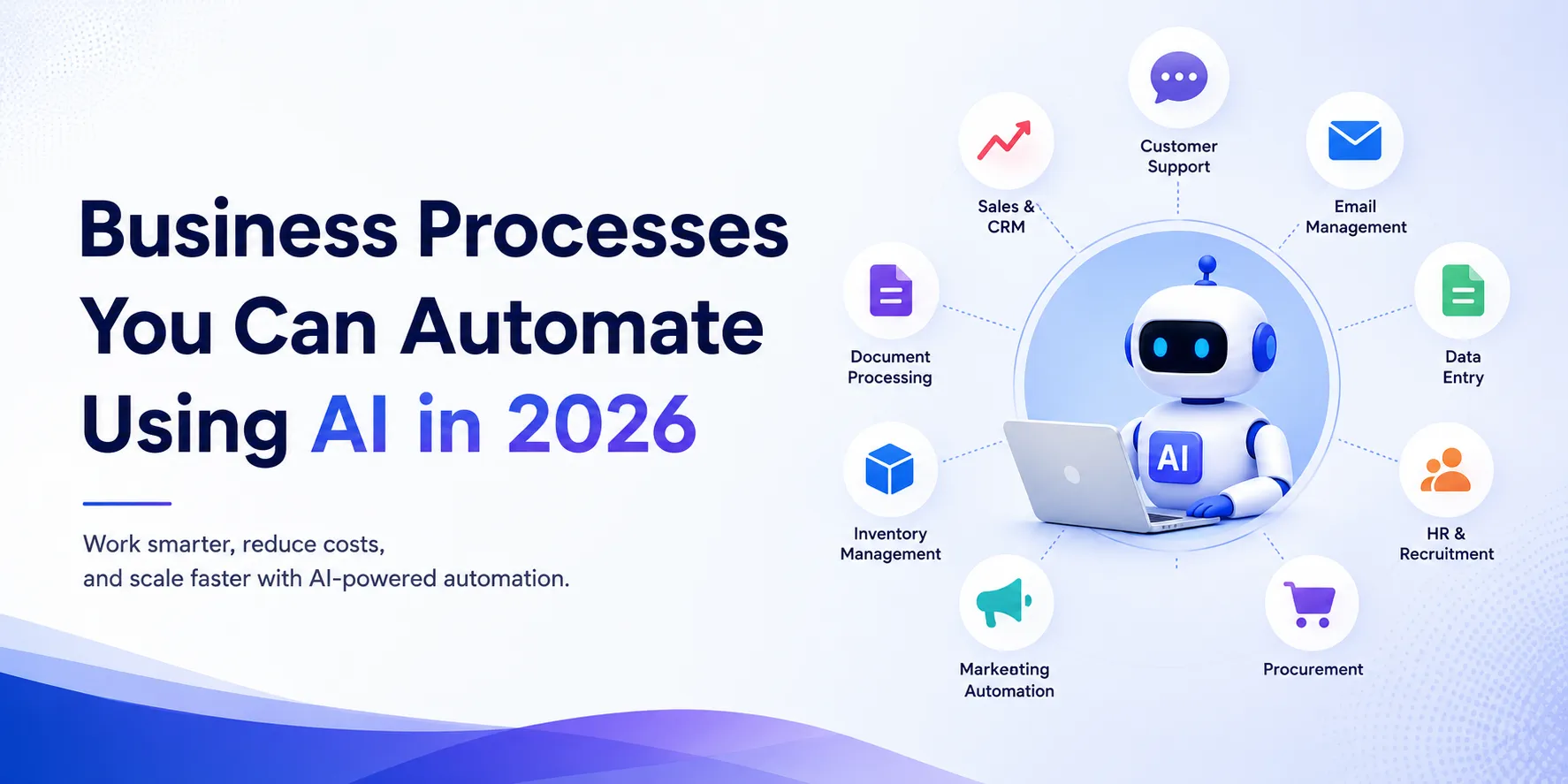
- Finance & Invoice Processing
Manual invoice handling is one of the highest-cost, lowest-value activities in any organisation. AI can now extract data from invoices in any format — PDFs, scanned images, emails — match them to purchase orders, flag discrepancies, and route approvals automatically. What used to take a team of accounts payable staff several days can be processed in minutes, with a human reviewing only the exceptions that genuinely need judgment.
2. Sales Pipeline & Lead Management
From lead qualification and outreach to follow-up scheduling and CRM updates, AI automation removes the administrative drag from sales teams. AI agents can score inbound leads, personalise initial outreach, log interactions, and surface the right prospects at the right time — without a rep spending half their day doing data entry. The result is a leaner, faster pipeline where your salespeople focus on closing, not clerical work.
3. Customer Support & Query Routing
In 2026, the most effective customer support operations run a hybrid model: AI agents handle first-response queries, classify tickets, retrieve relevant information, and resolve routine issues instantly. Complex cases are escalated to human agents — but with full context already assembled by the AI, so the agent doesn't start from scratch. Response times drop, CSAT scores rise, and support teams can handle significantly higher volumes without proportional headcount growth.
4. HR Processes & Recruitment Workflows
Screening hundreds of CVs, scheduling interviews, sending offer letters, onboarding new hires — HR teams deal with an enormous volume of process-driven work. AI automation can shortlist candidates based on defined criteria, draft and send communications, coordinate calendars, and generate onboarding documentation, all without manual intervention. HR professionals are then freed to focus on culture, talent development, and the deeply human aspects of people management.
5. Supply Chain, Logistics & Inventory Management
Predictive AI is already transforming how businesses manage stock. Instead of reacting to shortages after they occur, AI models analyse historical sales data, seasonality patterns, supplier lead times, and external signals (weather, market demand) to recommend or automatically trigger reorders. Logistics scheduling, shipment tracking, and exception management are increasingly handled by AI agents that coordinate across systems in real time.
6. Marketing & Content Operations
From generating first-draft copy and scheduling social posts to running A/B tests and reporting on campaign performance, AI is deeply embedded in modern marketing stacks. The important caveat — and one worth emphasising — is that AI-generated content still benefits enormously from a human editor who understands brand voice, audience nuance, and strategic context. The most effective approach is human-assisted automation: AI handles the volume, humans handle the judgment.
7. IT Operations & Compliance
Routine IT tasks like access provisioning, software updates, incident classification, and audit log generation are prime automation candidates. AI-powered IT ops platforms can detect anomalies, route support tickets, and enforce compliance policies automatically — reducing response times and human error while maintaining robust audit trails that satisfy regulatory requirements.
✓
Invoice & Finance Processing
Extract, match, and route approvals automatically across any document format.
✓
Sales Pipeline Automation
Score leads, personalise outreach, and update CRM without manual entry.
✓
Customer Support Triage
Instant first response, smart escalation, full context for human agents.
✓
HR & Recruitment Workflows
CV screening, interview scheduling, and onboarding without manual steps.
✓
Supply Chain & Inventory
Predictive reordering, logistics coordination, and real-time exception handling.
✓
IT Operations & Compliance
Incident classification, access provisioning, and automated audit trails.
The AI Automation Tools Leading the Market
The platform landscape in 2026 has matured significantly. The tools leading the market share a common thread: they help teams move past static, rule-based flows and build systems that respond in real time, use predictive intelligence, and connect insight to action. Choosing the right platform depends on your team size, technical capability, compliance requirements, and the complexity of your workflows.
Here are the categories of tools worth evaluating:
Enterprise-Grade Platforms
For large organisations with complex, multi-system workflows, platforms like UiPath and Automation Anywhere remain leaders — combining RPA with AI agents, process mining, and governance frameworks. These are built for scale, with audit trails, SSO, and compliance certifications built in.
UiPath
Automation Anywhere
Celigo
Camunda
Low-Code / No-Code Platforms
For ops teams and SMEs without heavy engineering bandwidth, low-code tools have become remarkably powerful. They allow business users to build, test, and deploy automations without writing a single line of code — dramatically reducing the gap between identifying an automation opportunity and acting on it.
Zapier
Make (Integromat)
Airtable Automations
Microsoft Power Automate
n8n
AI Agent Platforms
The newest category — and arguably the most exciting. AI agent platforms go beyond triggering tasks; they deploy intelligent agents that can navigate multi-step processes, make decisions, use tools, and escalate to humans when needed. These are becoming the backbone of next-generation workflow automation.
Lindy.ai
Wrk
Vellum
Notion AI Automations
⚡ Key selection criteria
Before committing to any platform, evaluate: breadth of native integrations, quality of the API, granular permissions and audit logs, pre-built template libraries, and — critically — whether the tool handles unstructured data or only structured inputs. The best AI automation tools in 2026 do both.
The Human-in-the-Loop Principle
Here is where many organisations get the balance wrong. The goal of AI business automation is not to remove humans from the equation entirely — it is to remove humans from the parts of the equation they should never have been in. No one becomes a business analyst to spend their day copy-pasting data between spreadsheets. No recruiter joins HR to manually send 200 interview confirmation emails.
The businesses getting the best return from AI automation in 2026 are those operating on a human-assisted model: AI handles the volume, velocity, and routine decisions; humans handle judgment, exceptions, relationships, and strategy. This is not a compromise — it is a design philosophy. And it significantly de-risks the transition, because there is always a human checkpoint where it genuinely matters.
"If your ambition is to build human-assisted automation with AI at optimised cost, you are not just keeping pace with your competitors — you are building a structural advantage that compounds over time."
Where to Start: A Practical Approach
The biggest mistake organisations make is trying to automate everything at once. The smarter approach is to start with your highest-volume, most-predictable processes — the ones where the input and output are well-defined, errors are costly or time-consuming, and your team spends the most hours on repetitive execution.
Map out your top five manually intensive workflows. For each one, ask: is this process repeatable? Is the data structured (or can AI help structure it)? Is there a clear success criterion? If the answer to all three is yes, you have a strong automation candidate. Start there, measure the time and cost savings, and use those wins to build internal confidence and funding for the next wave.
Scalability is the often-overlooked benefit. Automated workflows scale with your business without adding coordination overhead. As your team grows, your processes become more consistent, not more chaotic. Compliance improves because every action is logged and auditable. And your best people — the ones with judgment and domain expertise — spend their time on work that actually requires them.
The Competitive Reality
The AI boom is not a bubble, and it is not a threat — at least not to the businesses paying attention. Yes, there is hype. Yes, some tools are oversold. But underneath the marketing noise, the underlying capability is genuinely transformative. Invoice processing that used to take days now takes minutes. Customer queries that used to require a trained agent are resolved instantly. Supply chains that used to react to disruptions are now predicting them.
The businesses that will struggle are not the ones that adopt AI too slowly — it's the ones that adopt it thoughtlessly, automating for automation's sake, without a clear operational goal or a human oversight layer. Done well, AI workflow automation is one of the highest-leverage investments a business can make in 2026. The compounding effect of hundreds of small, well-designed automations — each saving time, reducing errors, and freeing human capacity — is what sustainable operational excellence looks like in practice.
The choice is not whether to engage with the AI era. That ship has sailed. The choice is whether to wield it as a competitive weapon — or watch your competitors do it first.